
Product Knowledge

Compressed Natural Gas/CNG with the best quality

Product

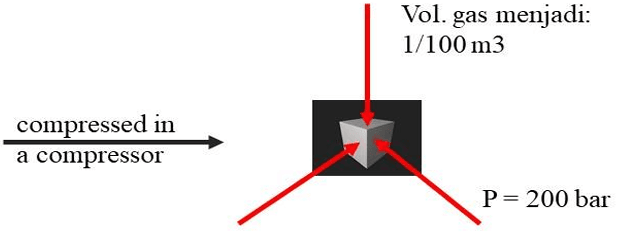
Theoretical review of Compresses Natural Gas (CNG), Compressed natural gas.

This means: Under conditions under 200 bar pressure, 1m3 of space can contain 100 m3 of natural gas, so it is economical to transport without going through a gas pipe (Virtual Piping). On the other hand, gas pipeline investment is very expensive and is related to the Right of Way (ROW), which in many cases is a challenge in itself.

The Difference between LPG and CNG

Liquid Petroleum Gas (LPG) Made out of C3 (butane)
and C4 (ethane)

Characteristic : 

  1. Density is heavier than air (udara): 1,89 kg/m3 vs. 1,29 kg/m3,
  2. Calorific value is approx. 10.000-11.000 kcal/kg,
  3. Made through out process in a refinery (from crude oil) or LPG processing facility (from gas),
  4. Carbon emission is higher than that of natural gas/CNG,
  5. Stored as liquid in a LPG cylinder: +/- 8 bar.
Natural Gas (CNG) is dominatedby C1
(methane)

Characteristic : 

  1. Density is lighter than air (udara): 0,8 kg/m3 vs. 1,29 kg/m3, much less risk of explosion or catching fire.
  2. Calorific value is approx. 8.000 -9.000 kcal/kg depending on gas well location,
  3. No processing necessary,
  4. Carbon emission is lower than that of LPG,
  5. Stored in a gas cylinder in form of gas phase: +/- 200-250 bar.

Procedure for Calculating Gas Bills to Customers

1.Pressur Gauge (PG)

Shows operating pressure of gas after leaving the PRS and adjusted to customer requirements.
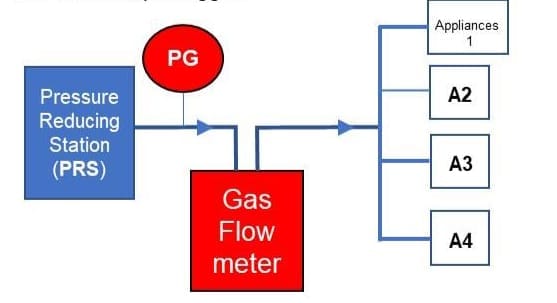
2.Flowmeter

Shows the amount of gas used under ACTUAL / NORMAL conditions (Operating Pressure and Operating Temperature):

FM number (start of month):X

FM figures (end of month): y

3.Y-X=VA

namely the amount of Actual (Normal) gas usage/month in Am3 (Actual m3)


4. Calculating usage

To calculate usage, Actual / Normal Conditions must be converted to Standard Conditions at Atmospheric Pressure and Temperature 27 ℃ with the formula below.

Information :

Vs: CNG Volume AT STANDARD CONDITIONS : Temperature of 27 ℃ (300 Kelvin) and pressure of 1 atmosphere (1.01325 bar) used by the customer and billed in the billing receipt in Sm3 (Standard cubic meters).

VA: CNG volume according to gas flowmeter designation measured at operational pressure P ops (Barg) and operational temperature T ops (℃) in Am2 (Actual cubic meters).

P ops Operational pressure of the gas flowing through the gas flowmeter in Barg.

T Ops: The operational temperature of the gas flowing through the gas flowmeter is in degrees Celsius (Centigrade).

K: Super Compressibility Factor (Super Compressibility Factor), for P ops ≤ 4 bar, K is considered = (1 + 0.0002 P ops).


5. Customer bills based on m3 (Sm3) standards are:
Bill Nominal (Rp)=Vs (Sm3) x Hrg.Gas (Rp/Sm3).

CNG Installation at Customer

Outside installation:

Connection between tubes  -PRS-Flow meter : SBE responsibility.

Inner Installation :

The connection between the Flowmeter - to equipment such as stoves (High and Low press), boilers, heaters, burners, etc., is the customer's responsibility.

CNG Installation at Customer (PMS)

Objectives

  1. To find out whether the consumption of Compressed Natural Gas (CNG) compared to Liquefied Petroleum Gas shows a savings in operational costs.
  2. The data required is Historical data on the ratio between LPG costs and revenue (%) in the last 12 months.
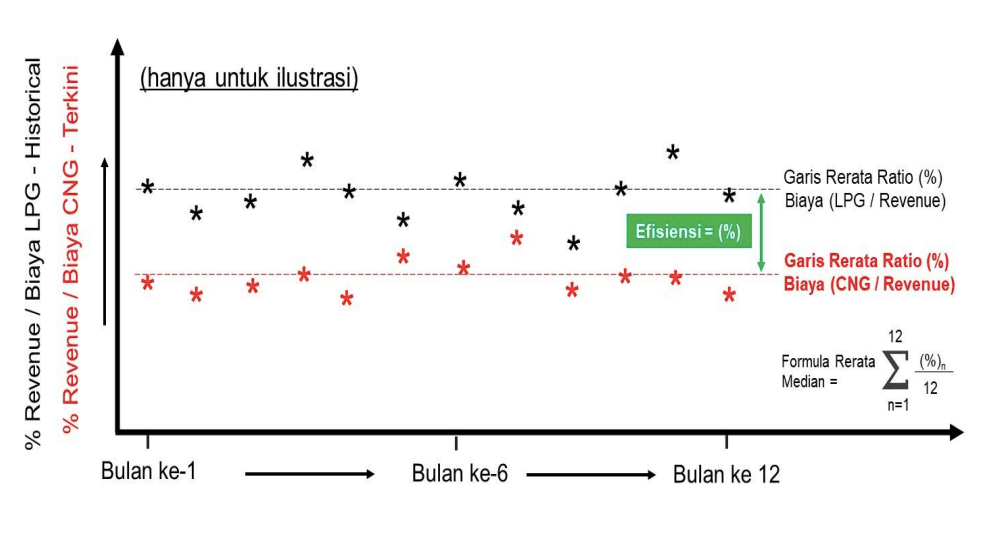
  3. PMS Procedure: This PMS is designed to compare historical data with the latest CNG usage data which will be monitored over a period of 6-12 months (PMS procedure see illustration).

Procedure

  1. Historical data ratio of LPG usage costs compared to Revenue in (%). Revenue is income from restaurants/hotel restaurants that use LPG. This historical data does not need to be taken from January, any month can be used as an initial start and end 12 months later.
  2. From historical data, the mean line (%)(Mean Median Line) can be determined.
  3. Monthly acquisition data for CNG revenue cost ratio (%). Revenue is income from restaurants/hotel restaurants that use CNG.
  4. From the monthly acquisition data, the mean % line (Mean Median Lne) can be determined.
  5. After 6 months, you can see whether using CNG provides efficiency compared to LPG.
  6. The difference between the two average numbers is the number EFICIENCY %

Service Level Commitment

GTM distribution and main equipment are provided by PT.SBE, namely:

  1. Tube at  customer (adjusted to Daily Vol +buffer),
  2. PRS (Incl.Hater)
  3. Flow meter
  4. Outer Installation

Service Level Commitment (SLC):

  1. Customer complaints will be responded to by SBE technicians within a maximum of 3 (hours), 7×24 hours a week.
  2. Perhagantian parts (apabila diperlukan) akan direspond oleh teknisi SBE dalam waktu maksimal 2×24 jam.
  3. Periodic installation maintenance once a month.
  4. Additional services for servicing stoves, boilers and burners, etc., for customers outside the gas price.
  5. Installation of additional piping both outside/inside if the customer wants to add equipment at the customer's expense in addition to the gas price.

Customer Data Form before conversion to CNG
(current data)

Mohon input Format "dd/mm/yyyy"